IELTS Academic Reading Test - BC Reading 5
This is your IELTS Reading test. You should spend about 60 minutes on Questions 1-40.
You will have 60 minutes to complete the test.
Practice mode scores are not stored in your profile.
IELTS Academic Reading Test - BC Reading 5
This is your IELTS Reading test. You should spend about 60 minutes on Questions 1-40.
Central Heating
Questions 1-13
Central heating refers to any system which warms a building by circulating heated fluid - most often air, water or steam - through its rooms, usually via piping or ducts. Throughout history, most central heating systems have used a fundamentally similar principle. The technology has advanced over time and some modern systems are impressively sophisticated, but essentially still work in the same way. Most modern central heating systems work by blowing hot air through ducts or pumping hot water through pipes.
The first evidence of humans controlling home temperatures dates as far back as 3000 BC. Egyptologist Bob Briar notes that temperatures in Egypt are extreme due to a lack of humidity in arid desert regions, ranging from 0°C at night to 50°C at noon. Ancient Egyptians employed clever architectural design techniques to regulate this, incorporating pools of water into their homes which helped to channel the cool desert breeze inside during the day, while storing daytime heat to create a comfortably habitable climate at night.
Central heating systems as we would recognise them today were invented in Ancient Greece around 350 BCE. These early designs were fuelled by a central furnace, from which hot air was circulated throughout the building via a hypocaust - a series of brick pipes built into the walls and floors. However, these systems were only found within the homes of the affluent, as well as some public buildings such as temples. Later, hypocausts were also employed by the Ancient Romans to heat their public baths, where they were used to warm the sweat rooms. In some towns, geothermal energy was also harnessed via a local system of hot springs which filled the baths to temperatures of over 70°C.
Around the turn of the 19th century, another form of central heating was developed which circulated steam instead of hot air. In his home, inventor of the steam engine James Watt built the first working system in the 1790s, aided by his associate Matthew Bolton. The prototype included one of the first radiators, which was made of copper and was likely considerably smaller than modern radiators due to the high temperatures steam allows. This benefit was also one of the technology's drawbacks as it increases the chance of burning. Steam systems are considered more dangerous, complex and noisy than other types of central heating. As a result, they are rarely used to heat individual homes these days. However, they are used on larger scales, probably the most famous example being the New York City steam system in lower Manhattan. Every year, it pumps 11 million tonnes of steam from generating stations into local apartments and businesses.
Hydronic heating systems are probably the most common type of heating in modern homes. They heat water in a central boiler and pump it through metal pipes to the rest of the building. One of the first examples was used in 1710 to heat the Summer Palace in St Petersburg, Russia. However, it wasn't until 1836, when an English civil engineer called Thomas Tredgold developed the technology, that these systems really took off. This was followed by rapid development of the technology and by the late 19th century low-cost radiators could be found across the USA and Europe. By 2011, at least 83% of all English and Welsh households used gas or oil boilers within hydronic central heating systems.
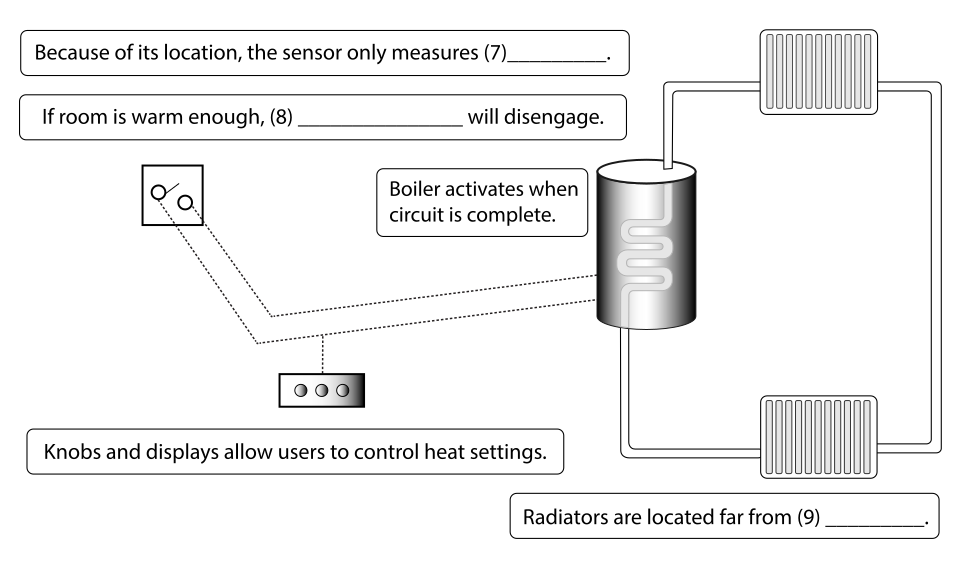
A crucial part of these modern systems is the thermostat. This is a device containing a sensor to detect the ambient temperature of the room and is most commonly used to switch a boiler on and off. It is located far from the water heater itself, usually in the middle of the house, and the two devices are connected by two long wires. By placing it at a significant distance from any radiators, it can more accurately measure the ambient temperature. The user sets their desired temperature by turning a knob or programming a digital display via buttons. When the sensor detects that it is too cold, it connects the two wires together, activating the boiler. After the heat has risen to an appropriate level, it disconnects the two wires, which shuts off the heat.
So-called smart thermostats have entered the market recently and allow homeowners to control the temperature of their houses more precisely by incorporating smart phone apps and advanced timers. Some can also even learn homeowners' habits and adapt automatically to suit their needs. They can be easily retrofitted to many existing central heating systems thanks to the fact that even the most advanced models function in essentially the same way - they simply turn the boiler on when it is too cold and off when it is too hot. Fitting one is often simple, involving removal of the old thermostat using a screwdriver and attachment of the new, smart model into the same socket.
Modern central heating systems are much more efficient than ever before. Because it is only activated when necessary, the boiler consumes less energy overall. Some smart heating systems even have the ability to detect which rooms are occupied and operate radiators to ensure only those which are in use are heated. Efficiency will continue to be a driving force in the improvement of system designs, as energy prices continue to rise. While looking for ways to reduce energy bills and the cost of the technology decreases, consumers will turn to smart central heating systems to meet their heating needs.
Questions 1-6
Choose the correct heating system for each statement. Write the correct letter A-E for each answer.
A Egyptian system
B Greek system
C Roman system
D Steam system
E Hydronic system
Questions 7-9
Label the diagram below. Write NO MORE THAN TWO WORDS from the text in each answer box.
Questions 10-13
Complete the notes. Write NO MORE THAN THREE WORDS from the text for each answer.
The Island of Skye
Questions 14-27
Skye is truly a landscape fashioned by geology. Renowned for its ancient formations, this rugged island is home to some of the oldest rocks on Earth. The sheer variety of life demonstrated by these fossils can be explained by the different climatic conditions which Scotland underwent as a result of the movement of huge tectonic plates, causing this country to drift northwards from an original position near the South Pole to the equator, and beyond. Over huge periods of time, the island endured everything from arctic conditions to a tropical climate and even hot deserts, resulting in some of Scotland's most dramatic scenery, with towering pinnacles looking out over the Atlantic.
The island's oldest rocks are the Lewisian gneisses of the Sleat Peninsula, formed underground 2.8 billion years ago from a variety of even older rocks. These were forced to the surface about 1.1 billion years ago before being buried by several thousand metres of gritty and pebbly sandstones from fast-flowing rivers. Looking down upon the island from above, large extinct volcanoes - now much eroded - can be seen forcing their way through the centre of this ancient mass, forming the island's lofty Cuillin hills. From their famous jagged peaks, peregrines and golden eagles watch over the lands below. Apart from these raptors and the occasional rock climber, these heights are devoid of life. It is necessary to descend a little in order to reach the first upland inhabitants of the island, the abundant red deer, which thrive here thanks to Skye's distinctive geology.
Towards the end of Scotland's last glacial period, approximately 15,000 years ago, a huge sheet of ice completely covering the island began to melt, exposing stony soils. This, combined with the island's position on the exposed west coast of Britain, notable for its above-average rainfall, resulted in extremely boggy terrain. Plants attracted to the resulting acidic conditions - such as sedges and lichens - began to colonise the landscape, followed by scattered alpines and a variety of rare plants including butterwort, notable for its unusual method of trapping and consuming insects on its sticky leaves. These prove ineffective against larger herbivores though, including the aforementioned deer who feed indiscriminately. Interestingly, perhaps due to the red deer's dominance, there are relatively few other established land mammal populations on the island. However, with the recent opening of the Skye Bridge, connecting the island to the mainland, further species - most notably pine martens, elusive woodland creatures similar to large weasels - have also arrived and settled permanently.
Although the distance from the northernmost point of Skye to its southernmost is a mere 65 miles, the island's coastline amounts to an extraordinary 456 miles. This gives some idea of the intricate coastline and all the bays and headlands that surround Skye and harbour the majority of its unique ecosystems. Fishermen, as well as otters and mink, are attracted to the rich abundance of shellfish to be found in the island's coastal inlets and reefs. Above these, the high columnal cliffs provide nesting spots and lookouts for white-tailed sea eagles which take fish and the aforementioned small mammals directly from the sea. Below these cliffs, Skye's numerous grey and common seals can be spotted entering and exiting the sea from their bases on the many flat islets around the southern and western coast, which mirror a geological feature of particular note known as 'MacLeod's tables' - flat-topped hills formed by the erosion of paleocene lavas. One further feature of Skye's coastal geology is that the sheltered inlets provide an ideal refuge for groups of dolphins and porpoises, away from the storms of the Atlantic.
Further out towards this oceanic expanse, a wealth of species take advantage of the nutrient-rich waters typical of the Sea of the Hebrides. The first benefactors are plankton, which bloom each Spring and attract a host of predators including forage fish, such as herring. The most renowned visitor to the island's waters, the colossal basking shark, also feasts during these springtime occurrences and can often be spotted from island viewpoints doing so. Vast kelp forests, which thrive in such waters, especially on relatively shallow bedrock to which they can easily anchor, dominate the seabed further out to sea and play a vital role in maintaining the nutrient quota. The plant's incredible height - up to thirty metres - also provides living space for a number of species. In addition, when the vegetation eventually dies, it produces flakes of plant material which break down and dissolve, in the process providing food for single-celled animals.
The vast windy open waters to the south-west of Skye mean it has great potential as a base for wind farms and the harvesting of renewable energy, though this is not the only example of Skye's inhabitants benefitting from their host's billion-year history. Land in the east of the island, where limestones created a smooth well-drained area of grassy slopes, were long ago found to be particularly fertile and continue to be farmed. Nowadays it is wildlife and outdoor tourism that form the main economy of the island. In recent years, tourism itself has been boosted thanks to the featuring of the island in films, such as Prometheus which prominently featured the striking blocks and pinnacles of the Trotternish peninsula, the result of basalt lava landslides around fifty million years ago.
Questions 14-16
Complete the sentences below. Use NO MORE THAN TWO WORDS AND / OR A NUMBER from the text for each answer.
Questions 17-20
Choose TRUE if the statement agrees with the information given in the text, choose FALSE if the statement contradicts the information, or choose NOT GIVEN if there is no information on this.
Questions 21-27
Complete the table. Write NO MORE THAN THREE WORDS for each answer.
| Geological Feature | Effect | Result |
|---|---|---|
| The shifting of tectonic plates | Scotland forced past the equator | Skye experienced a range of |
| Exposure of stony soil by melting glacier and higher-than-normal | boggy, acidic terrain | growth of plant life |
| Very extensive coastline, sheltered bays | Space for a large amount of marine life in shallow waters | The rich waters off the Skye coast are good for fishing and provide plenty of food for animals such as |
| Very extensive coastline, sheltered bays | The coastline offers protection for animals when there are out at sea. | Appearance of dolphins and porpoises |
| Shallow ocean bedrock | ideal conditions for the growth of | Dead plant matter provides nutrition for unicellular organisms |
| Large stretches of | Construction of wind farms | Inhabitants benefit from the production of electricity |
| Dramatic landscapes formed over millions of years | The appearance of the island in several | An increase in the number of tourists |
Rationality Communities
Questions 28-40
A Rationality is defined as the quality or state of being reasonable. Being a "rational person" involves basing one's decisions on consideration of facts and logical thinking, rather than on intuition, belief and emotion as is the natural tendency of human beings. The study of rationality is a blend of philosophy, economics, sociology, psychology, evolutionary biology and political science. People who identify as "rationalists" strive to improve their critical thinking and decision-making skills in order to live in a more rational manner.
B Since the turn of the 21st century, rationality has experienced a rising popularity and several devoted online communities have formed to champion and teach rational thinking. Perhaps the most notable of these is Less Wrong, a community started in 2006 by artificial intelligence researcher Eliezer Yudkowsky and economist Robin Hanson. Any community member can participate by attending regular 'physical' meetups in different cities around the globe or spark debate by posting on its website or forum. User Raemon attempts to define what “the rationalist community” consists of. He outlines two levels of the community as he sees it: the ‘Rationalsphere’, comprising everyone with an interest in rationality, regardless of their interest in joining a community; and the ‘Rationality Community’, containing those who want to connect over their interest.
C He goes on to define features of those two levels. In reference to the ‘Rationalsphere’, he adds 'overlapping patterns of thought', stating that, although there is no one feature to define people in this camp, they share some habits and patterns, such as being attentive to the unreliability of one's mind or being willing to change one's preconceived ideas. He further highlights three focus areas: truthseeking, impact and what he simply terms as ‘human’. The first deals with aiming to improve our thinking and applying that knowledge to better understand the world, while the next concerns applying that new mindset to make a real difference in the world. The final focus area relates to one's own life and how it can be improved along with the lives of those close to us through the application of rationality techniques. The 'Rationality Community' is still centred on these same ideals, yet is able to focus on them more intensely due to being directly involved with a like-minded set of others. The two aforementioned camps along with the focus areas mentioned are active rationality community examples of Yudkowsky's theory that it is possible to improve the quality of our decision-making processes by applying logic and understanding of probability to our day to day lives.
D The standard process for debate on Less Wrong involves community-generated articles prompting responses from other community members through the Less Wrong voting system. Readers can award points for the usefulness or not of the piece, from which users are awarded 'karma'. The higher this is, the more respected and valued a user's contributions are deemed to be. Through this system on its website and forum, Less Wrong community members debate concepts such as decision making and economic theory, for example, as well as training each other in practical techniques. The project has spawned other rationality communities, including the Center for Applied Rationality, a non-profit organisation in Berkeley, California which runs workshops on critical thinking and setting goals, and offline clubs, such as the New York City Sceptics and Bay Area Rationalist Community.
E One motivation for the study of rationality techniques is the view that humans are naturally irrational creatures. Science writer David Berreby notes that people generally cannot tell when they are being rational, cannot become more so by willpower alone and often believe their behaviour is rational when, in fact, it is not. He raises the example of court judges, whose remit is to be unbiased authorities of the law. In a research study conducted by German psychologists Englich, Mussweiler and Strack, it was found that judges who rolled a die before adjudicating a case would give a longer sentence if a higher number came up than those who rolled a lower number. This demonstrates that even trained rational thinkers - and judges surely fall into this category - are influenced by natural irrational tendencies.
F However, not everyone thinks that people are naturally irrational and require “fixing”. Dr Steven Mazie, a correspondent for The Economist, believes this idea stems from what he calls a "faddish denial that human beings can think straight". He is of the opinion that humans are rational creatures, despite the current trend to cast them in the opposite light. Other commentators have also called into question the fundamental basis of rationality communities such as Less Wrong - that being irrational is a bad thing. Henry Brighton, professor of computer science at Tilburg University, explains that objective data is a rarity in most real-world situations. As a result, logical formulations are an inappropriate method of decision-making and most important decisions rely, at least partially, on a person's subjective preferences.
Questions 28-31
The text has six paragraphs (A-F). Look at the paragraphs. Which paragraphs mention the following points? Write the appropriate letter, A-F.
Questions 32-33
Choose TWO letters from A-E and write them in any order in the answer boxes.
Questions 34-35
Choose TWO letters from A-E and write them in any order in the answer boxes.
Questions 36-40
Choose the correct person for each statement. Write the appropriate initials for each answer.
EY Eliezer Yudkowsky
DB David Berreby
EMS Englich, Mussweiler and Strack
SM Steven Mazie
HB Henry Brighton
