IELTS Reading: Skills Introduction Handout 2
Read the three passages and answer Questions 1-15.
You will have 30 minutes to complete the test.
Practice mode scores are not stored in your profile.
IELTS Reading: Skills Introduction Handout 2
Read the three passages and answer Questions 1-15.
Stammering
Questions 1-4
The terms stammering and stuttering both refer to the same speech disorder. The word stammering is mostly used in British English, while the word stuttering is more common in American English. A person who stammers has trouble producing words fluently. The disorder causes them to repeat or elongate sounds, words or syllables. A stammer can also manifest itself as pauses in speech.
In order to understand stammering, we first need to understand how the voice is produced. The human voice begins when air is pushed from the lungs through the vocal folds, which are more commonly known as the vocal cords. These vocal folds are housed within the larynx, or voice box, which serves the dual purposes of producing sound and stopping food from entering your lungs. The muscles of the lungs, throat and body are precisely coordinated by the brain to produce intelligible speech. People stammer because their brain has trouble coordinating all these muscles.
Scholars have researched the causes of stammering since as far back as the Ancient Greeks, although the most enlightening research is more recent. Current research using Magnetic Resonance Imaging (MRI) scanners has found that stammerers have an abnormality in part of the brain called Broca's area, which is involved in moving the mouth muscles and producing speech. Researchers have also found that stammering has a genetic element. Dr Dennis Drayma identified three gene mutations which are very common in families that have a history of stammering. Therefore, if someone in your family had a stammer, there is a higher likelihood that you or your children will also stammer.
People have tried to find a cure for stammering since 300 BC. The Greek politician Demosthenes had several problems with his voice, including a stammer and trouble pronouncing the letter 'r'. He enlisted the help of actor Satyrus, who told him to put pebbles in his mouth to cure the stammer. This has the effect of slowing down the speech, which can ease stammering. It is still a recommended strategy these days, although there are more effective strategies. Throughout history, people have also resorted to surgery to try and cure their stammering, including cutting the frenulum, the connective membrane which attaches the underside of the tongue to the floor of the mouth, stretching the tongue and cutting the nerves which control it. Given what we now know about stammering, it seems unlikely that these strategies were successful.
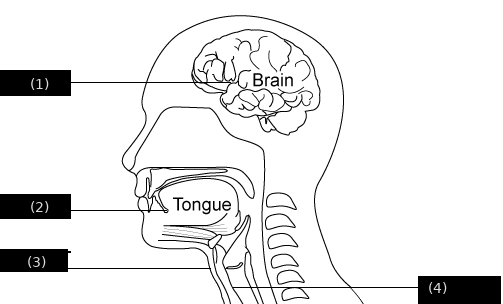
Questions 1-4
Label the diagram below. Write NO MORE THAN TWO WORDS from the text in each answer box.
What is Intelligence?
Questions 5-11
Howard Gardner, a psychologist at Harvard University, has formulated an even more intriguing theory. He arranged human intelligence into seven sections. First of all, Gardner characterises logical-mathematical intelligence as people who think logically and are able to transfer abstract concepts to reality. These people enjoy solving puzzles and can be good inventors because they can visualise an invention even before making a prototype. They normally do better in school, which is for the most part due to the fact that schools are designed for the logical-mathematical type of thinkers.
The linguistic type, as you might guess, is the natural born writer and poet. They usually have excellent storytelling skills, spelling skills, and love to play with words. They tend to be bookworms and can easily learn more than one language. This type of intelligence seems to be located in the Broca’s Area, since damage to that portion of the brain will cause a person to lose the ability to express themselves in clear grammatical sentences, though that person’s understanding of vocabulary and syntax remains intact.
Next Gardner traced musical intelligence to certain areas of the brain. Impaired or autistic children, who are unable to talk or interact with others, have often exemplified exceptional musical talent. People of this type of intelligence show great aptitude for music, have excellent pitch, and a good sense of rhythm. They concentrate better with music playing in the background. A particular concerto by Mozart has shown positive changes in the brains of listeners. Thus, musical intelligence can be a form or a means of learning.
Another form of intelligence is interpersonal intelligence. This category is for people who are very well aware of their environment. They tend to be sensitive to people around them, have an excellent idea of how people behave and are especially sociable. Politicians, leaders, counsellors, mediators and clergy are excellent examples of people with this type of intelligence. Damage to the frontal lobe has shown damage to this type of person’s personality and his or her ability to interact with others.
Intrapersonal intelligence is almost the opposite of interpersonal intelligence. This kind of intelligence deals with how well you know yourself. People who possess a higher degree of this type of intelligence have high self-esteem, self-enhancement and a strong sense of character. They are usually deep thinkers, self-teachers, skilled in music or art and have an inner discipline. This sort of intelligence is hard to measure since it is often difficult to recognize externally.
Spatial intelligence is the ability to perceive and interpret images or pictures in three-dimensional space. The right hemisphere of the brain has been proven to control this form of intelligence and scientists are certain that spatial intelligence is clearly an independent portion of this intellect. A person of this intellect enjoys making maps and charts.
Lastly, Gardner classifies people who are athletically inclined as body-kinesthetic intelligence. They perform the best in atmospheres of action, touching, physical contact and working with their hands. Dancers and athletes are good examples of this form of intellect. Critics are a little sceptical that Gardner considers this a form of intellect since it is only a physical component of intelligence, but nonetheless, the brain does use both hemispheres to control movement.
Questions 5-11
Choose the correct personality type for each statement. Write the appropriate letters for each answer.
A Logical-mathematical type
B Linguistic type
C Musical type
D Interpersonal type
E Intrapersonal type
F Spatial type
G Body-kinesthetic type
Wildfires
Questions 12-15
A Wildfires are fires occurring either in the countryside or an area of wilderness. They are different from other fires in that they are uncontrolled, are much larger, and are able to spread out rapidly from the original source at speeds of up to 23 kilometres per hour. They are also able to ‘jump’ over gaps such as roads and even rivers. Wildfires occur in countries that have a lot of vegetation and a hot, dry climate. They are most commonly found in Australia due to the weather conditions of the country. They pose a danger to human and animal life and the infrastructure throughout the year, but are especially prevalent in the warmer months of spring and summer. The United States also has a huge number of wildfires with an estimated sixty to eighty thousand a year, resulting in a loss of between three and ten million acres of land annually. In 1910 a single wildfire burnt over three million acres of land in the US.
B Ninety per cent of wildfires are ignited by people, the remaining 10 per cent by lightning. Common human-generated causes of wildfires include arson, camping fires, careless disposal of lit cigarettes, bonfires lit to burn rubbish and children playing with fireworks or matches. Three components are necessary to start a fire: oxygen, fuel and heat. These three make up the so-called “fire triangle” that fire fighters use to put out blazes. The theory is that if they can remove one of the triangle pillars, they can take control of and eventually extinguish the fire.
C The speed at which wildfires spread depends on the fuel around them. Fuel is any living or dead material that will burn. Types of fuel include anything from trees, underbrush and grassland to houses. The quantity of inflammable material around a fire is known as “the fuel load” and is determined by the amount of available fuel per unit area, usually measured in tons per acre. The dryness of the fuel also influences how fires behave. Dry fuel burns quickly and makes the fires much harder to control. Basic fuel characteristics affecting a fire are size and shape, arrangement and moisture, but with wildfires, where fuel usually consists of the same type of material, the main factor influencing ignition time is the ratio of the fuel’s total surface area to its volume. The surface area of a twig, for example, is not much bigger than its volume, so it ignites rapidly. However, a tree’s surface area is much smaller than its volume, so it requires more time to heat up before ignition.
D Three weather variables affect wildfires: temperature, wind and moisture. Temperature directly influences the sparking of wildfires, as heat is one of the three pillars of the fire triangle. The sun heats and dries sticks, trees and underbrush, turning them into potential fuel. Higher temperatures can cause fuels to ignite, burn more quickly and add to the speed of a wildfire’s spread. Consequently, wildfires tend to rage in the afternoon, when temperatures are at their hottest. The biggest influence on a wildfire is probably the wind. This is also the most unpredictable variable. Winds provide fires with extra oxygen and more dry fuel, and make wildfires spread more quickly. Fires also create winds of their own that can be up to ten times faster than the ambient wind. Winds can spread embers that generate additional fires, an event known as “spotting”. Winds also change the course of fires, and gusts can take flames up into trees, starting “crown fires”. Humidity and precipitation provide moisture, the last of the three weather variables. Higher levels of humidity mean fewer wildfires. It is hard for fuel to ignite if moisture levels are high and humidity slows fires down and reduces their intensity.
Questions 12-15
Answer the questions. Use NO MORE THAN THREE WORDS from the text for each answer.
